
The Story of Chang’e and the Jade Rabbit

A woman rises to the moon. A white rabbit pounds medicine beside her. Far below, families lift their faces to the night sky and share round cakes under the brightest full moon of autumn.
That is the heart of one of China’s most beloved legends. The tale of Chang’e and the Jade Rabbit has been told for centuries in poems, paintings, children’s stories, festival songs, and family gatherings. It carries romance, sorrow, sacrifice, and a quiet kind of hope. Like many old myths, it has more than one version. Some tell it as a love story. Some tell it as a warning about desire. Others see it as a tale of loyalty, loneliness, and the human wish to reach what shines just out of reach.
At its center are three figures: Chang’e, the woman of the moon, Hou Yi, the heroic archer, and the Jade Rabbit, her gentle companion in the Moon Palace.

The world before Chang’e rose to the moon
In many versions of the legend, the story begins in a world scorched by too much light.
Long ago, there were said to be ten suns in the sky. Each sun took its turn crossing the heavens, bringing warmth and order to the earth. One day, all ten appeared at once. Their combined heat burned crops, dried rivers, cracked the soil, and made life nearly impossible.
People suffered. Plants withered. Animals searched for shade and water. The world needed someone brave enough to restore balance.
That person was Hou Yi, a master archer of unmatched skill. He climbed high, drew his bow, and shot down nine of the ten suns. By leaving one sun in the sky, he saved the world without plunging it into darkness.
This act made Hou Yi a hero. In some tellings, he was rewarded by the Queen Mother of the West, a powerful goddess associated with immortality. She gave him an elixir that could grant eternal life. Yet the gift brought a difficult choice. If Hou Yi drank it alone, he would become immortal and leave his wife behind. If he shared it, the versions differ on whether both could ascend or whether there was only enough for one.
Hou Yi loved Chang’e. Rather than abandon her, he kept the elixir hidden at home.
That hidden vial becomes the turning point of the story. What begins as a reward for saving the earth becomes a test of trust, fear, and fate.
Why Chang’e drank the elixir
The most familiar version says Chang’e did not drink the elixir out of simple greed. She drank it during a moment of danger.
Hou Yi had a student or follower named Feng Meng, sometimes described as jealous and cruel. He learned about the elixir and waited until Hou Yi was away. Then he entered the house and demanded that Chang’e hand it over.
Chang’e faced a terrible choice. If she gave him the elixir, a selfish person might gain immortal power. If she refused, he could take it by force. To keep it from him, she swallowed the elixir herself.
At once, her body became light. She floated upward, past the roof, past the trees, into the night sky. She did not choose the highest heaven. Instead, she came to rest on the moon, the nearest celestial place to earth.
That detail matters. It keeps the story tied to love. Chang’e does not vanish into a remote paradise. She remains where Hou Yi can still look toward her.
When Hou Yi returned and learned what had happened, he was heartbroken. He looked up and saw the moon shining with unusual brightness. In its glow, he thought he could see Chang’e’s shape. He placed her favorite foods outside as an offering, hoping his love could cross the distance between earth and sky.
This moment is often linked to the traditions of the Mid-Autumn Festival, when people gather under the full moon, give thanks for reunion, and eat mooncakes. The roundness of the moon and the cakes suggests wholeness, even in a story marked by separation.
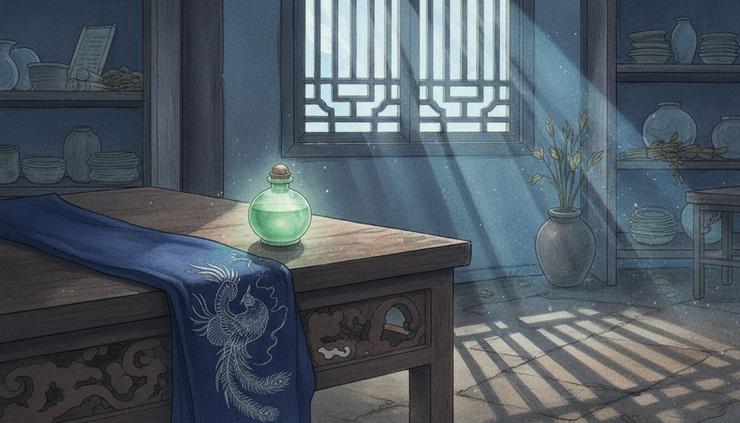
There is another version of the tale with a sharper moral edge. In it, Chang’e drinks the elixir because she wants immortality for herself. She rises to the moon, but the result is not joy. Eternal life becomes isolation. The Moon Palace is beautiful, yet cold and lonely.
Both versions have endured because both speak to real human fears. One asks what people sacrifice to protect what is right. The other asks what a person might lose by wanting too much.
Neither version turns Chang’e into a simple figure. She is not only a victim, a thief, or a goddess. She is a person caught inside a choice larger than herself. That complexity is one reason her story still feels alive.
The Jade Rabbit and the quiet work of devotion
The Jade Rabbit enters the legend as a companion on the moon. In Chinese folklore, the rabbit is often seen pounding herbs or medicine with a mortar and pestle. Sometimes the medicine is an elixir of immortality. Sometimes it is a magical remedy. In many paintings, the rabbit sits beneath a cassia or osmanthus tree near the Moon Palace, steady and patient.
The rabbit’s story also has its own Buddhist-linked version.
In that tale, three animals, often a fox, a monkey, and a rabbit, meet an old man who asks for food. The fox catches fish. The monkey gathers fruit. The rabbit, unable to find anything else to offer, gives itself as food by leaping into the fire. The old man is revealed to be a divine being, moved by the rabbit’s selflessness. He places the rabbit on the moon so all can remember its compassion.
This is why the rabbit is not just decorative. It stands for kindness, sacrifice, and faithful service. Beside Chang’e, the Jade Rabbit softens the loneliness of the Moon Palace. It gives the scene movement and purpose. While Chang’e gazes toward earth, the rabbit keeps working, grinding medicine in the silver light.
The image is simple enough for a child to picture, yet rich enough for poets and artists to return to again and again.
A white rabbit on the moon also connects myth to the way people watch the sky. Many cultures see shapes in the moon’s dark markings. Some see a face. Some see a person carrying wood. In East Asian traditions, people often see a rabbit. Once the eye finds it, the old story feels written across the sky.
Look at the full moon long enough, and the legend stops feeling far away. The shadows become a rabbit, a palace, a woman waiting in light.

The Moon Palace as a place of beauty and longing
The Moon Palace, sometimes called Guanghan Palace, is usually imagined as lovely but cold. Its beauty does not erase Chang’e’s sorrow. That contrast gives the myth much of its emotional strength.
On earth, Hou Yi remembers his wife. On the moon, Chang’e remembers the life she left behind. Between them hangs the vast sky, crossed only by moonlight, offerings, and memory.
This is why the legend fits so naturally with the Mid-Autumn Festival. The festival celebrates reunion, yet many people spend it missing someone. A family member may live far away. A loved one may be gone. A home may exist only in memory. The full moon becomes a shared point of attention. People in different places can look at the same moon and feel, for a moment, connected.
Mooncakes carry that meaning in edible form. Their round shape echoes the full moon. Families cut and share them, turning the symbol of completeness into a real act of togetherness. Lanterns, poems, and moon viewing add to the mood, but the emotional center stays simple: people gather, remember, and look up.
Chang’e’s story gives the moon a human face. It changes the night sky from something distant into something personal.
That may explain why the legend appears so often in art. Chang’e is painted with long sleeves flowing as if she still floats. The Jade Rabbit crouches near its mortar. An osmanthus tree shades the palace courtyard. Clouds curl beneath her feet. The scene feels weightless, but the feeling behind it is grounded in ordinary human longing.
Why the story still matters
Old myths survive when they keep finding new meaning. The story of Chang’e and the Jade Rabbit has lasted because it is more than an origin tale for a festival. It asks questions that still feel familiar.
What should a person do when all choices carry loss?
Chang’e’s decision, especially in the version where she protects the elixir, is not clean or easy. She saves the world from a dangerous person, yet she loses her home. The story honors sacrifice without pretending it feels painless.
What does love become across distance?
Hou Yi cannot bring Chang’e back. Chang’e cannot return to him. Yet the offerings, the moonlight, and the annual festival suggest that love can become ritual. It can become memory kept carefully over time.
What kind of immortality is worth having?
The legend does not present eternal life as simple happiness. Chang’e gains the moon, but loses the earth. The Jade Rabbit works on medicine for immortality, while the story itself hints that endless life without companionship may be a lonely gift.
What makes a small creature heroic?
The Jade Rabbit does not shoot down suns or fly to the moon through magic medicine. Its power lies in devotion. It gives, works, and stays. In a legend filled with heavenly forces, the rabbit’s gentleness may be its strongest quality.

These questions help the myth travel across generations. Children may first remember the rabbit. Later, they may understand Hou Yi’s grief, Chang’e’s impossible choice, or the bittersweet meaning of a full moon seen from far away.
The legend also reminds us that stories do not need one fixed form to be true in spirit. One family may tell Chang’e as brave. Another may tell her as regretful. A poem may focus on loneliness. A festival song may focus on reunion. Each version keeps one part of the moonlit picture.
The lasting power of the tale comes from that mix of light and sorrow. Chang’e reaches the heavens, but she looks back. The Jade Rabbit gains a place among the stars, but keeps doing humble work. Hou Yi saves the world, but cannot save himself from loss.
The next time the full moon rises bright and round, the old story is easy to imagine. Somewhere in its silver glow, Chang’e stands in the Moon Palace. Near her, the Jade Rabbit lifts its pestle and returns to its patient task. Far below, people share mooncakes, speak of reunion, and look upward together.
The moon remains distant. The story brings it close.


Comments